
Altitude Xperience Pte Ltd (formerly known as Skyventure VWT Singapore Pte Ltd) v Simba Telecom Pte Ltd [2026] SGHC 133 (“Altitude Xperience v Simba”) is the first reported High Court decision on a COPIF 2018 dispute. We turn to the examine the Court’s decision and its future implications for building owners, developers and telcos.
Brief introduction to COPIF
Under the Code of Practice for Info-communication Facilities in Buildings 2018 (“COPIF 2018”), broadly speaking, building owners are required to provide rent-free “unused” space (i.e., Mobile Installation Space (“MIS”)) to mobile telecommunication service providers (“Telcos”) for the installation of their mobile equipment. The purpose of the COPIF is to ensure that developers/owners of buildings (“BOs”) provide adequate space and facilities, for the deployment and operation of equipment to be used to provide infocommunication services to their buildings and surrounding properties.
COPIF 2018 came into operation in December 2018. Disputes often arise between BOs and Telcos regarding the provision of space, mainly resulting from:-
The expiry of existing agreements / arrangements between Telcos and BOs for payment of charges / fees for the use of the BO’s space, COPIF 2018 does not operate to terminate such agreements, or to mandate that the spaces which are subject to these agreements are automatically converted to MIS. Upon expiry, Telcos may assert that they are entitled to continue using the space without charge, while the BOs prefer renewing the agreement or re-purposing the space for other use.
The term “unused space” is not defined under COPIF 2018. Where BOs had provided some space to Telcos to install their mobile equipment, but now wish to re-purpose that space which is housing the mobile equipment, the question is whether the space now falls outside the scope of “unused space” and is therefore incapable of being designated as MIS.
One such legacy agreement was the subject of dispute in Altitude Xperience v Simba.
The Facts and Court’s Holdings
Simba Telecom (formerly TPG Singapore) leased ground floor and rooftop spaces (the “Spaces”) from Altitude Xperience, the BO, and deployed its mobile equipment there since around September 2017. Simba made certain payments to the BO for the use of the Spaces pursuant to their oral / written agreements. However, it was disputed whether parties had reached an agreement for use of the Spaces after September 2019.
The BO claimed that Simba had only paid for use of the Spaces until September 2019, after which there was no agreement for the licensing of the Spaces. Therefore, Simba was trespassing on the BO’s property since September 2019. In addition, the Spaces could not be designated as MIS since it was not “unused space”. The BO had planned to install additional aircon units on the rooftop, which would be rented out to host events (and generate income for the BO). As an aside, the term “unused space” is not defined in COPIF.
Simba claims that the Spaces fell within the definition of “MIS” and therefore it was entitled to use the Spaces free of charge since the COPIF 2018 came into operation in December 2018. However, the payments made to the BO were a goodwill gesture for transition into the COPIF regime.
The Court found that, on the facts, Simba had only made payments for the use of the Spaces up to 19 September 2019. Further, the parties did not arrive at any agreement for Simba to use the Spaces after 20 September 2019.
As to whether Simba would be liable for trespass, the issue turned on whether the Spaces are “unused spaces” under COPIF, which would determine whether they constituted MIS. If so, Simba was entitled to use the Spaces rent-free and would not be liable for trespass.
The COPIF provided that in the event of a dispute the parties could refer the matter to IMDA for a final and binding determination. The Court opined that such a determination would involve complex technical facts and issues of policy, for which IMDA is best equipped to handle.
When Simba referred the matter to IMDA for determination in 2021, IMDA issued its decision that the rooftop space was not “unused space” and therefore did not constitute rent-free MIS under COPIF. IMDA also directed the BO to complete installation of the aircon units within 12 months, failing which IMDA may designate the space as MIS. In 2024, the Minister upheld IMDA’s decision. Simba did not apply for a quashing order against the Minister’s decision.
Therefore, the Court held that Simba was never entitled to use the Spaces free of rent under COPIF. Since Simba had occupied the Spaces since September 2019 without the BO’s agreement / authorisation, the Court held that this amounted to trespass. Simba was ordered to pay damages of $698,594.50 to the BO.
Effect of future COPIF Amendments
This is perhaps the first time that a COPIF 2018 dispute of this nature has been decided by the Singapore High Court, and there have been 2 recent cases decided by the State Courts. Despite the proposed amendments to be made to the COPIF, these may not be the last cases to be litigated in the courts.
In March 2026, IMDA issued a consultation paper on a review of the COPIF. Among other things, IMDA proposes to amend the COPIF as follows:
- First, MIS locations have to be identified upfront and incorporated into the development designs of new developments. The idea is that Telcos and BOs can plan and deploy mobile equipment before residents and tenants move in, avoid costly retrofitting works, and speed up mobile coverage enhancement works.
- If this approach entails removing the term “unused space” from the COPIF, it may reduce or eliminate issues of whether certain spaces should be designated as MIS depending on whether the BOs intend to use it for another purpose.
- However, without clear timelines and engagement processes, this may inadvertently lead to protracted discussions / disputes between Telcos and BOs during the design / construction phase.
- Second, on the issue of legacy agreements, IMDA proposes an “auto-conversion” approach. Briefly, where parties have entered into a written agreement for the provision of MIS, the space identified as MIS shall be automatically designated as MIS after the expiry or termination of said agreement unless and until (i) the parties agree otherwise; or (ii) IMDA makes a written decision that the space shall no longer be MIS.
- This amendment, if passed, will introduce welcome clarity post-termination / expiry of such agreements.
- However the issue of whether the space is indeed rent-free MIS still remains, as the spaces leased/licensed under such agreements may not be designated as MIS in the first place. This could resurrect issues of whether the spaces are “unused” especially where BOs could generate alternative revenue from them.
- Third, upon the transfer of a property from one BO to another, any MIS provided by the outgoing BO shall be automatically designated as MIS in respect of the incoming BO unless, and until (i) the parties agree otherwise; or (ii) IMDA makes a written decision that the space shall no longer be MIS. This however does not fully address the situation where the space is not designated as MIS in the first place (which is typically the case where there is an existing agreement / arrangement between the parties, and where IMDA has not made a binding determination).
Concluding Thoughts
This decision is significant for both building owners and Telcos.
If such existing agreements expire in the near future and are not renewed or re-negotiated, and the BOs intend to use the space for another purpose, this may result in deadlocks which would require parties to agree on an alternative location and who bears the relocation costs. If the space is not already designated as MIS, IMDA may have to step in to make a binding determination. Alternatively, parties may consider appropriate short-term extensions so as to reduce commercial uncertainty and potential liability in damages.
Where such disputes have been referred to the IMDA for a decision, parties should await the outcome before turning to the Court for a resolution. Otherwise, the Court may stay the proceedings until IMDA has issued its decision, to avoid multiplicity of proceedings (see MCST Plan No. 4234 v Simba Telecom Pte Ltd [2025] SGDC 263).
Telcos that have installed mobile equipment on building premises cannot assume that they are entitled to use the space rent-free after the agreements expire. Unless there has been a clear pronouncement on this, Telcos may be liable in trespass and damages may extend to loss of revenue that could be generated by the building owner from the space.
Building owners should be cognisant that they are obliged under the COPIF to provide MIS. If building owners take matters into their own hands and remove the Telco’s equipment prematurely, they may find themselves at the risk of liability for hefty reinstatement costs if the space is found to be rent-free MIS.
It remains to be seen whether Simba will apply for a quashing order against the Minister’s decision or an appeal against the High Court’s decision. Watch this Space.
In the High Court case of BP Projects Pte Ltd v One Wind Pte Ltd and others [2026] SGHC 105 (“GD”), the 1st to 3rd Defendants were liable in fraudulent misrepresentation to the Claimant in connection with a “missing trader fraud” situation, and were ordered to compensate the Claimant the sum of S$1,747,483.65, being the GST refunds which were disallowed by IRAS.
Key Facts
In mid-2015, Mr. Chua Boon Poon (representative of the Claimant, BP Projects Pte Ltd) met D3 (Mr. Ong Kian Meng) and D4 (Mr. Ong Kian Seng) at City Square Mall.
D3 and D4 invited the Claimant to embark on a business venture involving the sale and subsequent on-selling of IT products (e.g. smartphones, software) (“Products”).
Under the proposed arrangement (“Arrangement”):
- BP Projects would first confirm orders from overseas buyers in Vietnam and Malaysia.
- BP Projects would then order the Products from D1 (One Wind Pte Ltd) and D2 (Jueltech Trading Pte Ltd).
- D1 and D2 would then buy the Products from their suppliers and deliver them to BP Projects to on-sell to the overseas buyers.
- Overseas buyers would pay BP Projects the purchase price without GST (as these exports were zero-rated).
- BP Projects would then pay D1 and D2 the purchase price with GST included.
D3 informed BP Projects that it would be able to claim GST refunds on the sums paid by BP Projects to D1 and D2.
The Claimant alleged that these representations induced them to enter the Arrangement, which later led to financial losses.
Here are 5 key takeaways from this case.
1. Missing Trader Fraud is a Fraudulent Scheme Targeting the GST System
A description of a “missing trader fraud” arrangement was set at [9] of the GD, with reference to IRAS’ website.
As IRAS explains on its website:
“Missing Trader Fraud is a fraudulent scheme targeting the GST system. It typically involves fictitious transactions orchestrated by a network of individuals and businesses designed to illicitly claim GST refunds or avoid tax obligations.
Perpetrators of the Missing Trader Fraud often create chains of sales and purchases transactions involving real or fictitious goods or services. A business upstream in the supply chain typically collects GST from subsequent buyers but vanishes without paying the GST to IRAS. GST-registered buyers downstream in the supply chain then claim from IRAS the GST paid to the upstream suppliers. This results in a loss of government revenue.
To form the fraudulent supply chain, perpetrators may use borrowed identities to register fictitious businesses to enable other entities in the chain to claim fictitious GST refunds from IRAS. Your business could also become a party in the fraudulent supply chain, for example, when you accept offers from perpetrators to buy and sell goods in return for a guaranteed profit with little or no risks.”
(Emphasis in bold added)
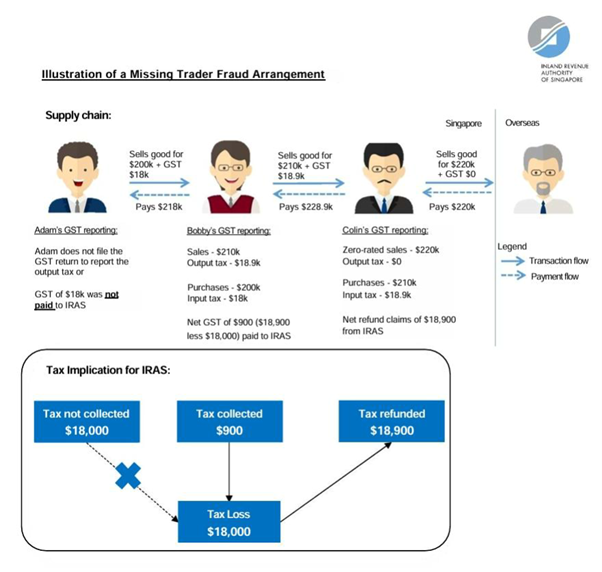
The Court also referred (see GD at [10]) to the following diagram from IRAS’ website which provides an illustration of a “missing trader fraud” arrangement:
2. IRAS Took the Position that D1 and D2 were Part of a “Missing Trader Fraud” Arrangement
IRAS investigated the transactions and took the position that D1 and D2 were part of a “missing trader fraud” arrangement (D1 and D2 failed to pay the correct GST to IRAS), and disallowed GST refunds in the amount of S$1,747,483,65 to the Claimant (see GD at [9], [58]).
IRAS imposed various additional tax assessments and penalties on D1 and D2, which also covered the period of the Claimant’s transactions (see GD at [35]).
With reference to the IRAS illustration above, the Claimant was somewhat analogous to the position of “Colin” (save that “Colin” would have been disallowed the GST refund of S$18,900, similar to how the Claimant’s GST refunds were disallowed by IRAS).
3. Two Key Misrepresentations were made by D3, and Attributed to D1 and D2
The two key representations found to be false were:
- D1 and D2 complied with all the relevant rules and regulations relating to GST (“Compliance Representation”);
- The Claimant “would have no issues claiming for the abovementioned GST refunds” (“Refund Representation”).
The Court found that D3 made these representations.
Since D3 had the authority to represent D1 and D2 and did act on behalf of them at the material time, his acts and mental state are properly attributed to D1 and D2 so that they are so liable as well.
In this regard, D3 is the director of D1 and the Operations Manager of D2. On D3’s own account, he “managed the business of both [D1] and [D2]”.
See GD at [12], [23], [31], [64] (read with [3]).
4. Elements of Fraudulent Misrepresentation Were Made Out
The Court set out the elements of fraudulent misrepresentation at [15] of the GD.
The Court went on to find that:
- D3 made the representations, and these were representations of fact (including the Refund Representation, which is a representation of the law, which is also a representation of fact) (GD at [23]-[39]).
- The representations were made with the intention that the Claimant would act upon them (GD at [41]-[43]). The Refund Representation and the Compliance Representation (together with other representations) were undoubtedly material, as they collectively portray the Arrangement as a viable or even tried and tested method of making profits.
- The Refund Representation and Compliance Representation were false (GD at [43]-[51]). Amongst other things, D1 and D2 did not comply with the relevant GST rules and regulations.
- The Claimant relied on the misrepresentations (GD at [52]-[54]). Even though Mr. Chua had conducted very basic research by checking IRAS’ website, nothing indicated that he had any in-depth understanding of the working of GST or that he possessed any tax-related expertise.
- The Claimant suffered losses in reliance on the misrepresentations (GD at [55]-[58]). This was in the form of IRAS disallowing its GST refund claims in the amount of S$1,747,483.65. In this regard, the Court found that the payments the Claimant received from overseas buyers for the Products were consistently less than the sums that the Claimant had to pay D1 and D2, which included GST components. The Claimant, therefore, would only make a profit if it could claim GST refunds and undoubtedly suffered losses from its GST refund claims being disallowed.
The Defendants also attempted to argue that the Claimant’s losses stemmed from regulatory intervention, instead of from their misrepresentations. The Court disagreed. IRAS’ intervention took place because D1 and D2’s failure to pay the correct GST constituted a “missing trader fraud” and not for any other independent regulatory purpose.
- D3 was reckless in making the misrepresentations (GD at [59]-[63]). See Point 5 below.
5. State of Mind: Recklessness Suffices to Establish Misrepresentation
It is important to note that the Court found that D3 acted recklessly rather than with knowledge that the misrepresentations were false.
In this regard, D3’s lack of understanding of how to ensure compliance with GST rules and regulations and the implications of not doing so, which was the complete antithesis of the Compliance Representation and Refund Representation respectively, stretched back to the time when he made the misrepresentations. In other words, D3 made the misrepresentations without caring whether they were true or false. On that basis, D3 acted recklessly in making the misrepresentations.
See GD at [59]-[63].
Conclusion
Recklessness, in the sense of making a misrepresentation without caring whether they were true or false, suffices to meet the requirement of falsehood for fraudulent misrepresentation. Actual knowledge that they were false at the time of making the misrepresentation is not necessary.
It is therefore crucial that key representations of fact (which includes representations on the law) leading up to the entering of business ventures or contracts be made only after checking the accuracy of such facts.
As the Court observed at [1] of the GD, “The tax authorities in Singapore are not shy when it comes to enforcing the payment of taxes that are properly due.”
May contractual parties likewise not be shy about checking their facts when making important representations in business negotiations.
What has Common Intention Constructive Trust (“CICT”) got to do with coffeeshop rent?
You might be thinking of ordering, “Uncle, 1 Kopi-O C-ICT pls!”
But no, such an exotic local legal drink does not exist (yet). And it has nothing to do with CICT.
The main facts of the CICT and coffeeshop rent case have been reported in the press at least twice.
First, when the plaintiff Mr. Tia Oon Lai (“TOL”) successfully sued the estate of his late mother (“Mother”) and obtained a 37.65% share of 10 years of rent (previously paid by Koufu) for a Yishun coffeeshop from October 1998 to June 2018 (“Previous Rental”). The Mother and TOL were tenants in common in equal shares of the coffeeshop (under a 30-year lease from HDB).
See:
- Straits Times article dated 10 June 2025 (https://www.straitstimes.com/singapore/courts-crime/man-who-sued-mums-estate-gets-38-share-of-rent-for-yishun-coffee-shop-over-two-decades); and
- the High Court’s grounds of decision in Tia Oon Lai v Tia Sock Kiu Sally [2025] SGHC 108 (“HC Judgment”)
Second, when the High Court Judgment was reversed on appeal to the Appellate Division of the High Court.
See:
- Straits Times article dated 6 May 2026 (https://www.straitstimes.com/singapore/courts-crime/man-loses-share-of-rent-from-yishun-coffee-shop-as-sisters-win-appeal-over-late-mums-estate); and
- the Appellate Division’s grounds of decision in Tia Sock Kiu Sally v Tia Oon Lai [2026] SGHC(A) 14 (“AD Judgment”).
Here are 5 key takeaways from this case.
- Who Beneficially Owned the Coffeeshop – the Law on CICT
There is no easy answer to the question: who beneficially owned the coffeeshop?
On record, the Mother and TOL were tenants in common in equal share (i.e. 50:50 owners) of the coffeeshop.
However, they each contributed unequal amounts towards the purchase price and did not execute a declaration of trust.
This is where CICT comes in.
Regardless of the parties’ financial contributions to the purchase price of the property, if there is sufficient evidence of an express or an inferred common intention that the parties should hold the beneficial interest in the property in a particular proportion, the parties will hold the beneficial interest in accordance with that common intention (see AD Judgment at [36]).
On appeal, contrary to the High Court decision that TOL was entitled to a 37.65% share, the Appellate Division found that there was a common intention between the Mother and TOL, at the time the lease was acquired, that the Mother would hold the full beneficial interest in the lease, and that the Mother had relied on the common intention to her detriment.
As such, the Mother also held the full beneficial interest in the Previous Rental, and TOL was not entitled to any part of it.
See AD Judgment at [40].
- Direct Financial Contributions, Bank Loan, Repayment from Rental
For the purposes of CICT, although direct financial contributions to the purchase price of the property are an important consideration, they are not the only basis upon which the court may infer a common intention.
In exceptional situations, the conduct of the parties may give rise to an inferred common intention.
An example of such an exceptional situation is when neither party can be said to have made any direct financial contributions towards the purchase price of the property in the typical manner because the property was financed by a mortgage for which repayments were made using rental proceeds from the property.
In this case, apart from a cash payment of S$354,154.80 made by the Mother (using her own funds), neither the Mother nor TOL made any direct financial contribution towards the purchase price as the remainder of the purchase price was financed by a 1998 bank loan which was repaid using the coffeeshop rental.
That is why the Appellate Division had to look closely at the parties’ conduct over the years, to see whether a common intention may be inferred.
- Exceptional Situation: Inferred Common Intention – from Conduct
The common intention was inferred from the conduct of the parties, and include the following:
- That the Mother worked at the coffeeshop and was regarded by others as the “lady boss” who assisted the father in running the coffeeshop, whereas TOL was not involved in the coffeeshop operations since its relocation in 1984.
- That it was the Mother who was actively arranging for the financing of the purchase of the lease and the repayment of the 1998 bank loan.
- That the Mother had made the cash payment of S$354,154.80 using her own funds, and had organised and marshalled the funds to make the lump sum mortgage payments. In this regard, the rental derived from the coffeeshop was used by the Mother to make both the monthly and lump sum mortgage payments.
- Having regard to the license / tenancy agreements over the years, while TOL could possibly have had some involvement in the renting out of the coffeeshop in the early years, by around 2008, it was primarily the Mother who was involved in these matters.
See AD Judgment at [48]-[54].
Significant weight was placed on a letter which Mother wrote in 2015 where, amongst other things, she said that “All the rental income from the shophouse belong to me…”, and in this letter, she was seeking to explain why the coffeeshop rental was being transferred and deposited into a tripartite account with her two daughters, Sally and Poh Kim. See AD Judgment at [65]-[72].
Much weight was also placed on TOL’s omission in 2018 to stake his claim (see point 4 below).
- Contemporaneous Objections are Crucial
TOL did not raise objections at two crucial junctures.
First, when Mother wrote the 2015 letter where, amongst other things, she said that “All the rental income from the shophouse belong to me…”. TOL was physically present when this letter was read out and signed by the Mother. However, TOL did not raise any query as to the contents of this letter at that material time.
Second, when Mother, TOL and Koufu entered into a “Rental Splitting Agreement” in August 2018 (whereby the rent moving forward from August 2018 onwards would be split equally between the Mother and TOL). However, TOL did not take this opportunity to pursue a share of the Previous Rental prior to July 2018.
In fact, TOL’s omission to make any claim for the Previous Rental both before and after the Rental Splitting Agreement was signed, until after the Mother passed away, strongly suggests that he believed that he was not entitled to a share of the Previous Rental.
See AD Judgment at [15]-[17], [68]-[72], [80]-[88].
- Observations
In summary, when family members deal with each other with respect to property and money of a substantial amount, it would be prudent to put things down clearly in writing – especially when it comes to determining the beneficial owners of shared property (and in what proportion), and where the direct financial contributions are insufficient to shed light on the common intention of the parties.
Conduct of the parties at the start and throughout the years then become critical to infer any common intention.
In any event, the failure to raise objections at crucial junctures could be held against the person who ought to have raised them – and even swing the balance against them in the final analysis.
Recent road traffic incidents have once again drawn public attention to the devastating consequences of motor accidents. Some may recall the widely reported Tanjong Pagar crash in 2021, where five able-bodied young men perished in a burning vehicle. Others may remember cases involving young children, including a recent incident where an infant pillion rider lost his life following a collision. And most recently, the accident along a busy section of Chinatown where a six-year-old girl tragically lost her life.
Such tragedies inevitably raise difficult legal questions, both civil and criminal.
Civil Claims following a fatality
Where a deceased is an infant or minor, an administrator of the estate must first be appointed before any legal claim can be pursued. In most cases, the natural parents will apply for a Grant of Letters of Administration to act on behalf of the estate.
The quantification of damages may differ significantly depending on the circumstances. For an adult who has an established career path, their demise may give rise to a substantial dependency claim based on their projected lifetime earnings. In contrast, claims involving very young children are more legally complex, as future earning capacity is necessarily speculative.
While no sum can compensate for the loss of a child, the law attempts to provide financial recognition of the loss within established legal principles.
Serious Injury Claims
For survivors who suffer serious injuries, compensation typically covers:
- Pain and suffering based on the nature and severity of injuries;
- Medical expenses (past and future);
- Transport and ancillary expenses;
- Loss of earnings (both pre-trial and future loss of earning capacity); and
- Future care needs, where applicable
In particularly traumatic cases, psychiatric injury may also arise. For example, a parent who directly witnesses a child being fatally injured may, in certain circumstances, have a claim for the traumatic symptoms they have suffered, subject to legal thresholds established by case law. Each situation turns heavily on its facts.
Contributory Negligence and Parental Responsibility
Questions of liability are often highly fact-sensitive. This is especially so in tragic road accidents involving young children. But beyond the headlines and the heartbreak lies the difficult and often uncomfortable legal question – who, as a matter of law, bears responsibility?
Would a young child who runs across the road in the path of an oncoming car bear any responsibility? According to the Singapore Court of Appeal in Ang Eng Lee and another v Lim Lye Soon [1985-1986] SLR(R) 931, a young child of eight years can be capable of contributory negligence. He or she can be expected to exercise reasonable care not to run across the road in the path of an oncoming vehicle and he or she ought reasonably to have foreseen the danger. Thus, potentially reducing the driver’s liability and consequently, the amount of damages claimable by the child’s estate.
What about the child’s parents? For example, would a parent be considered contributorily negligent by failing to supervise their child while crossing a busy public road? There are currently no judicial pronouncements from the Singapore Court of Appeal on this. However, guidance may be drawn from persuasive authorities. In Ellis v Kelly [2018] EWHC 2031 (QB), the English High Court held that parents could be contributorily negligent if they are found to have fallen below the standard of a reasonable parent. The inquiry is objective: the court will ask whether the parent took reasonable steps to safeguard the child, having regard to the child’s age, the nature of the hazard, and the surrounding conditions.
While such findings are understandably sensitive, particularly in cases involving serious injury or death, the law’s focus remains on apportionment rather than moral blame. The central question is not whether the parent is at fault in a colloquial sense, but whether his or her conduct fell below the legal standard of reasonable care in the circumstances.
In Singapore, this enquiry is further complicated by the fact that many children in Singapore are cared for by other relatives like grandparents, or domestic helpers, while the children’s parents both work full-time to support the family. In the heartbreaking case of the River Valley road accident that took place in January 2024, a four-year-old child who was under the care of her domestic helper had run across a road when she was hit by a car and sadly, passed away. The domestic helper was subsequently charged with causing grievous hurt by performing a rash act, although the charge has since been reduced to endangering the child’s life by a negligent act (as the helper had not held the child’s hand while they were walking home). The criminal case against the domestic helper is still ongoing, but questions remain as to the culpability and standard of care to be enforced against a caretaker who is not the child’s parent.
The Criminal Dimension
As foreshadowed above, beyond civil liability, serious road traffic accidents frequently attract criminal investigation. The authorities may consider charges against a driver where there is evidence of dangerous or careless driving causing death or injury.
Recent sentencing trends suggest that custodial sentences are increasingly imposed in serious cases, particularly where aggravating factors are present. Courts assess a range of considerations, including the degree of negligence, harm caused, and the broader public interest in deterrence.
Public Scrutiny and Modern Realities
In today’s digital environment, road traffic fatalities often receive intense public attention. Unlike in the past, incidents are widely discussed on social media platforms, oftentimes accompanied by video footage or commentary on the parties’ conduct.
While public discourse does not determine liability, perceptions of conduct, including post-incident behaviour, may indirectly influence the broader narrative surrounding a case. In criminal proceedings, courts remain guided by legal principles rather than public sentiment.
Conclusion
Every road traffic tragedy carries profound emotional and legal consequences. Civil claims seek to provide financial redress within the limits of the law, while criminal proceedings address questions of culpability and deterrence.
Each case turns on its specific facts. Early legal advice is crucial to ensure that rights are preserved, estates are properly administered, and potential claims are assessed accurately.
If you require advice in relation to a road traffic accident, our team would be able to assist.
Creditors might generally be reluctant to embark on litigation in order to recover debts owing from an insolvent company or bankrupt – even if it involves a complex and highly disputed claim. This is understandable since the prospects of success and eventual recovery may be limited. To save time and costs, they would much rather file a proof of debt and have it adjudicated by the liquidator / private trustee in bankruptcy (PTIB).
The case of Yit Chee Wah (as private trustee of the estate of Chan Siew Lee Jannie, a bankrupt) v Fulcrum Distressed Partners Ltd [2026] SGHC(A) 1 provides guidance on when the proof of debt regime is unsuitable for resolving such claims, and what to do next.
Background
This case concerned the admission/rejection of certain parts of a proof of debt filed against the bankruptcy estate of Ms Jannie Chan Siew Lee.
The liquidators of Timor Global Pte Ltd (“TGPL”) filed a proof of debt against Ms Chan’s bankruptcy estate for four sums, including the TL Sum and Finished Goods Sum which were the subject of the appeal.
TGPL was in the business of agricultural trading, such as coffee beans. It was involved in a joint venture with a Timor Leste company, Timor Global (TL) Pte Ltd (“TL”) and Intraco Trading Pte Ltd (“Intraco”) for the processing and trading of coffee beans, with the profits to be shared between TGPL and Intraco.
- Under the terms of the JV agreement:
(a) TGPL would place orders for processed coffee beans from Intraco, and Intraco would in turn order an equivalent amount from TL. Intraco would make an advance payment to TL to enable it to purchase raw materials from third parties, and then process them into coffee beans.
(b) Intraco would on-sell the coffee beans to TGPL at cost, who would then market and sell them to third party buyers.
(c) TGPL and Intraco split the profits according to a formula.
- At the material time, Ms Chan was one of the directors of TGPL, and a shareholder in TL.
The TL Sum was S$15,766,460 and referred to receivables allegedly owed by TL to TGPL as at 31 December 2014.
The Finished Goods Sum referred to a sum of US$2,301,767.43 which allegedly represented sales proceeds from coffee beans sold by TGPL in 2008 which were allegedly paid directly by TGPL’s customers to TL between 19 June 2008 and 14 November 2009.
The basis of the claim for both sums was that Ms Chan had breached her fiduciary duties as a director of TGPL. This arose because TGPL’s liquidators found discrepancies in the records of TGPL as to the amounts due from TL.
- TGPL subsequently assigned its claims against Ms Chan to Fulcrum Distressed Partners Ltd (“FDPL”).
Ms Chan’s private trustee in bankruptcy, Mr Yit Chee Wah, adjudicated the proof of debt and rejected the claims for both the TL Sum and the Finished Goods Sum.
(a) The TL Sum was rejected because (i) the documents did not provide satisfactory evidence that Ms Chan breached her custodial fiduciary duties to TGPL, and (ii) the claim was time-barred.
(b) The Finished Goods Sum was rejected because (i) there was insufficient evidence that Ms Chan instructed the customers to make these payments to TL or knew about them, and (ii) there was no evidence that Ms Chan directly benefitted from TL’s receipt of the Finished Goods Sum.
- FDPL appealed against Mr Yit’s adjudication decision to the Court, which found that:
(a) The TL Sum and the Finished Goods Sum were capable of being provable debts, if established by the evidence.
(b) The TL Sum should be admitted in full, and was not time-barred.
(c) The Finished Goods Sum should be admitted.
- Mr Yit appealed against the lower Court’s decision, to the Appellate Division of the High Court.
Legal Framework
The proof of debt regime is not meant to be used to adjudicate matters involving controversial disputes of fact. There is a policy of efficiency underlying this regime. When faced with a proof of debt that involves disputes of fact that cannot be easily resolved on documentary evidence, the liquidator/PTIB is entitled to reject it.
When serious allegations are made (such as misfeasance and fraud), this suggests that cross-examination of witnesses is necessary and it is inappropriate for the disputed claim to be resolved under the proof of debt regime. This is unless the serious allegation is clearly made out on the documentary evidence, or there is no serious dispute about the existence of such misconduct.
The proper recourse for a liquidator/PTIB when faced with factually complex disputes is to either (a) reject the proof of debt with reasons or (b) seek directions from the Court on the manner in which it should be resolved (pursuant to s 145(3) of the IRDA for corporate insolvency cases, or s 43(2) of the IRDA / s 40(2) of the BA for personal insolvency cases).
In the latter case, the Court may find that a full trial, or limited cross-examination of key witnesses, is necessary for the resolution of the issues. The paramount consideration is whether oral examination of witnesses and/or discovery is necessary for fairly disposing of the particular issue. This depends on the facts of each case, and the court will not order oral examination of witnesses where such an order would be unnecessary or oppressive. The court may also consider whether there are gaps in the documentary / affidavit evidence.
- These principles apply with equal force in both corporate and personal insolvency proceedings.
The Court’s Holding
The Appellate Division allowed the appeal and set aside the lower Court’s orders for Mr Yit to admit the TL Sum and the Finished Goods Sum. Instead, the Appellate Division ordered a full trial on the claims by FDPL against Ms Chan’s bankruptcy estate.
This was because the documentary and affidavit evidence did not clearly establish whether Ms Chan was in breach of her duty to act honestly and bona fide in TGPL’s interests in respect of the TL Sum and the Finished Goods Sum. Further, the material disputes of fact in relation to FDPL’s claims render them unsuitable to be decided without a trial. FDPL ought to be given an opportunity to properly prove its claims through the trial process.
- The five issues to be determined in respect of FDPL’s claims were:
(a) Whether the TL Sum represents a genuine debt owed by TL to TGPL, in particular, whether they were made pursuant to the JV agreement, or loans from TGPL to TL;
(b) What is the quantum of the TL Sum and the Finished Goods Sum;
(c) Whether Ms Chan authorised or caused TGPL to make payments comprising the TL Sum, and gave instructions to TGPL’s customers to pay the Finished Goods Sum to TL;
(d) Whether Ms Chan breached her fiduciary duties by failing to cause TGPL to recover the TL Sum and the Finished Goods Sum from TL (assuming they were genuine debts owed by TL to TGPL); and
(e) If the answer to the third or fourth issues were in the affirmative, whether FDPL’s claims against Ms Chan are time-barred.
Ordering a full trial was appropriate on the facts of the case. Ordering cross-examination of the deponents of the affidavits would not be sufficient. The points in contention had not been clearly defined, there were numerous gaps in the affidavit and documentary evidence, and certain individuals with knowledge of the material facts would have to be ordered to give evidence and examined in court.
- To give some examples:
(a) On the first issue, it appeared that TGPL had made payments of certain sums within the TL Sum to TL pursuant to the JV agreement (i.e., for TL to purchase raw materials and process them into coffee beans). If so, there could be no issue of any breach of fiduciary duty by Ms Chan. However the TL Sum also appeared as a receivable in the management accounts of TGPL, and there were significant unexplained variances between this and the company’s audited financials statements between 2005 and 2008. The directors/staff of TGPL who had handled these payments should give evidence on the reasons for these payments and might be able to shed light on the reasons why they were made to TGPL instead of TL, and why they were recorded as loans in TGPL’s books. Ms Chan had also made contradictory statements as to whether these were loans due from TL to TGPL, and the extent of her involvement in TGPL. These are clear material disputes of fact which ought to be resolved by way of cross-examination.
(b) On the third issue of whether Ms Chan authorised TGPL to grant the TL Sum and instructed customers to transfer the Finished Goods Sum to TL, the only evidence before the Court was an observation by TGPL’s liquidators that the books and records of TGPL were under the management and control of Ms Chan until its winding up, and that Ms Chan had signed off on TGPL’s financial statements and was an authorised bank signatory. There was however no evidence as to Ms Chan’s knowledge at the time the payments were made. This was also contradicted by Ms Chan’s evidence in her sworn statements on the extent of her involvement in TGPL. She ought to be cross-examined on these apparent contradictions.
(c) On the fourth issue, the legal test of whether a director had breached her duty to act bona fide and honestly is part-subjective and part-objective. For example, where she comes to know about a transaction which is against the company’s interest, believes that it is so, but does nothing to try to prevent the transaction or reverse it. The available evidence was insufficient to show that Ms Chan failed to cause TGPL to pursue the receivables, and the reasons for her acts and omissions. Causation was also an issue i.e., whether TGPL could have recovered the full sum even if it had pursued repayment from TL. Further evidence from Ms Chan, TL’s director and possibly staff from TL who handled their finances would be needed to determine this question.
Key Takeaways
The practical reality is that parties generally try to avoid litigation when it comes to recovering debts in an insolvency scenario, since it may be cheaper and more expedient to file and adjudicate a proof of debt. This judgement is a timely reminder that the regime’s policy of efficiency is a double-edged sword, which renders it unsuitable for resolving complex factual disputes. This is especially so where the claim entails serious allegations of misconduct that cannot be proved on documentary evidence alone.
Ultimately, both creditors and insolvency practitioners have to make a judgement call about what is the best way to resolve such claims. Appealing the adjudication decision may be low-cost in the short term, but could end up increasing costs in the long run, if the Court directs parties to head to a full trial. It may in some cases turn out to be more cost effective to refer the matter to Court and obtain an order for cross-examination of certain key witnesses, once the main issues have been distilled. As part of the recovery/adjudication strategy, the parties may consider whether incorporating alternative dispute resolution (such as mediation) could yield better outcomes.
If you would like to discuss the implications of this decision on your insolvency matters, we would be happy to advise.
In WPA v WPB & Ors [2025] SGHCF 24 (“GD”), the General Division of the High Court (Family Division) allowed the Plaintiff’s claim, to remove the 2nd Defendant as an executor of the estate (estimated between A$128m and A$150m) of their late mother (“Y”), due to inter alia conflicts of interest and for not performing his duties as an executor with due diligence and speed.
The Plaintiff was also substituted in as an administrator, despite the strenuous objections of most of the Defendants.
Characterist LLC’s Dominic Chan and Noel Oehlers successfully acted for the Plaintiff in this case.
Facts and Issues
The Plaintiff commenced the Suit in 2021, to remove the 1st and 2nd Defendants as the executrix and executor, respectively, of Y’s estate.
Section 32 of the Probate and Administration Act 1934 (2020 Rev Ed) provides that any probate may be revoked or amended for any sufficient cause. This requires the court to consider whether there has been an undue or improper administration of the estate in total disregard of the interests of the beneficiaries (Jigarlal Kantilal Doshi v Damayanti Kantilal Doshi (executrix of the estate of Kantilal Prabhulal Doshi, deceased) and another [2000] 3 SLR(R) 290 at [12]). Where, for instance, the executors are found to be tardy in distributing the assets of the estate or acting in conflict with the beneficiaries’ interests, the court may revoke a probate (UVH and another v UVJ and others [2020] 3 SLR 1329 at [73]-[74]). See [6] of the GD.
Whether the 1st and 2nd Defendants should be removed depended on secondary questions — whether they had acted in conflict of interests or, alternatively, they had been dilatory in their duties as executors to the extent that warrant their removal (see [7] of the GD).
It was one of the grounds of the Plaintiff’s claim that the 2nd Defendant was in a position of conflict of interests between his duties as an executor of Y’s estate and the negotiation and distributing of assets from the estate to himself (and the 3rd Defendant). The second ground of the Plaintiff’s claim was that the executors had not performed their duties with due diligence and speed (see [21] of GD).
Court’s Findings
The Court was satisfied that the Plaintiff had proven both claims (see [22] of GD).
Amongst other findings:
- It was precisely that the 2nd Defendant was representing himself, seeking payments out of the estate that affected his position as an executor. The act created a conflict of interests whether or not the Australian administrator of Y’s estate may have approved the payments (see [20] of the GD);
- There was no excuse in not administering the estate diligently (see [25] of the GD);
- The Court granted the Plaintiff Letters of Administration with Will Annexed in respect of the estate of Y, in substitution of the 2nd Defendant (see [28] of the GD) – this was despite strenuous objections by the 2nd, 3rd and 4th Defendants who alleged that the Plaintiff was not suitable to be the administrator (see [27] of the GD);
- The Court declined to substitute the 3rd and 4th Defendants in as administrators, for various reasons (see [26] of the GD).
The Plaintiff succeeded in proving both claims, i.e. conflict of interests (as against the 2nd Defendant only) and the executors not performing their duties as executors with due diligence and speed (save that the 1st Defendant was retained as an executrix, for other reasons (see [23] of the GD)).
Commentary
It is very important for an executor of an estate: (1) not to place himself or herself in a position of conflict of interests; and (2) to perform his or her duties with due diligence and speed.
Not abiding by such duties are potential grounds for possibly being removed and/or replaced by others.
In addition, even if an executor is removed, the Court would still have to go through the important exercise (which can give rise to highly contentious allegations between the parties) of determining who is suitable (or unsuitable) to be the replacement, after giving appropriate weight to and balancing all relevant factors.
Like the proverbial pink elephant in the room, one assumes that a ship is immediately and obviously identifiable. However, locally, and internationally, the definition of what is a ship has proved illusory, the criterion being “at sea” as it were.
Among the more unusual cases which have come up for determination would rank the following:
- Houseboats & floatels i.e. floating motels (The Environment Agency v Gibbs and another [2016] 2 Lloyd’s Rep 69, Addison v. Denholm Ship Management (UK) Ltd. [1997] I.C.R. 770);
- Flying boats (Polpen Shipping Co.v Commercial Union Assurance Co., Ltd (1942) 74 LI LR 157); and
- A remotely operated underwater vehicle (Guardian Offshore AU Pty Ltd v Saab Seaeye Leopard 1702 Remotely Operated Vehicle Lately on Board the Ship “Offshore Guardian” and another [2020] 1 Lloyd’s Rep 201).
To add to the list of curious cases, in the landmark case of Vallianz Shipbuilding & Engineering Pte Ltd v Owner of the vessel “ECO SPARK” [2023] SGHC 353 (“EcoSpark”), the Singapore Court had occasion to consider whether or not a floating fish farm (a modern day kelong in local parlance), was a ship for purposes of the HCAJA. In so doing, the Singapore Court has attempted to put forward a more comprehensive rubric by which to determine what is a ship, and this article wades into these murky waters by way of a case review.
The High Court (Admiralty Jurisdiction) Act 1961 (2020 Rev Ed) (“HCAJA”) is the legislation that sets out the ambit of the local Courts’ admiralty jurisdiction. Section 2 of the HCAJA defines “ship” as simply “any description of vessel used in navigation”. However, a neat definition of a “ship” or “vessel” has proved elusive. The High Court in EcoSpark has held (at [69]) that of necessity, the inquiry as to what constitutes a “ship” must be multi-factorial.
Practically speaking, the more ship-like characteristics one could tick off, the more likely the vessel is a “ship” and vice versa. However, the absence of certain characteristics does not immediately mean that the vessel is not a “ship”.
Relevant physical characteristics
Insofar as physical characteristics of a vessel were concerned, the “ability to self-propel, being possessed of a keel or a steering mechanism such a rudder, having a crew to man the ship, navigation lights, and ballast tanks” are usual physical characteristics (at [73]) and a vessel having all or most of these characteristics is more like than not to be a “ship”.
Design and capability of being used in navigation
At its very essence however, the Court noted that whether a vessel was “designed and capable of being used in navigation” was a weighty consideration in determining whether or not a vessel was a “ship” within the meaning of the HCAJA.
In that regard, a vessel must be designed to be capable of movement from one place to another on the water, but, need not be currently used to move from one place to another on water. Inasmuch as a car parked in a parking lot remains a car, a vessel not currently traversing the water (but capable of it) remains a vessel.
In addition, the Court declined to follow the line of authorities which hold that the vessel’s primary work should be executed while in navigation, and adopted instead the reasoning in the English Court of Appeal in Perks v Clark (Inspector of Taxes) [2001] 2 Lloyd’s Rep 431, that navigation can be incidental to another function such as dredging or providing accommodation.
Class and flag
Further to the above, the classification of the vessel, and registration and flag of the vessel in question has also been flagged out an important indication as to whether the vessel is a “ship” and/or “used in navigation”.
Conclusion
In this case, notwithstanding that the vessel the ECO SPARK, lacked many of the usual physical characteristics of a ship e.g. no engines, no crew, no navigational equipment, the Court noted that the vessel, being a converted dumb barge, was designed for and remained capable of being in navigation. The fact that she had special structures installed on top of the barge structure did not render her no longer navigable.
While the vessel was spudded down into the seabed and does not move on a daily basis, she is capable of being moved and remains capable of navigation. In addition, the fact that she had been towed from Batam to Singapore immediately prior to her use as a floating fish farm, and her capability of being classed (notwithstanding that her owners had not maintained her class status), pointed to her being a ship for the purposes of section 2 of the HCAJA.
In conclusion, this judgment is a timely and illuminative one and provides a greater degree of certainty and clarity as to when the admiralty jurisdiction of the Singapore courts is to be invoked.
Some of the more common offences a driver may face under the Road Traffic Act 1961 (the “RTA”) include “Reckless or dangerous driving” under Section 64 of the RTA (“Reckless Driving”) and “Driving without due care or reasonable consideration” under Section 65 of the RTA (“Careless Driving”). This article explores what these offences mean and the judicial approach to dealing with such offences, as well as some of the possible outcomes a person may face when charged with such offences.
Defining the Offences
First, when faced with a possible RTA offence, it is important to understand whether one’s conduct amounts to “carelessness” as opposed to “recklessness” which is more severe. These terms are not defined in the RTA but have developed over case law.
Broadly, recklessness involves the offender’s recognition of a risk (such as beating a red light, or driving under the influence) but ignoring that risk. Recklessness can also be made out where a risk is obvious but the driver unreasonably failed to consider it. Carelessness on the other hand is typically made out when a driver’s actions fall below what is reasonably expected of a competent driver.
Second, there are 4 degrees of harm involved in such offences: death, grievous hurt, hurt, and non-injury scenarios or property-damage-only cases.
“Hurt” is elevated to “grievous hurt” when among other things, a victim has suffered permanent blindness or hearing loss in either eye, amputation, permanent disfiguration of the head or face, permanent incapacity to a body part, a fracture or dislocation of a bone (including the cartilage in the nose) or has been placed on medical leave for 20 days or more. The full list may be found at Section 320 of the Penal Code 1871.
The dividing line between what is reckless and what is careless is not always clear but this line must be drawn as the fines and / or imprisonment terms imposed can differ significantly between Reckless and Careless Driving.
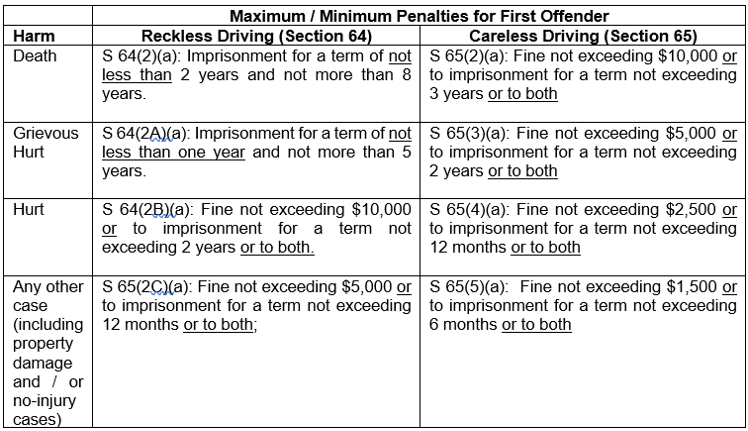
The table below lays out the minimum / maximum fines / terms of imprisonment for the offences of Reckless and Careless driving (not including any period of disqualification from driving which may be imposed). It may be observed that for certain levels of harm, the offence of Reckless Driving can carry mandatory minimum terms of imprisonment.
The Courts’ Approach to Sentencing
It is not possible here to lay out all of the possible considerations a sentencing Court may take into account. At this time of writing, the judicial approach to sentencing for Careless and Reckless driving appears to still be undergoing development.
Generally, the Courts tend to begin by considering the level of Harm caused, and the Culpability of the Offender to determine the starting sentence. A crucial consideration is whether the case warrants a jail term or whether a fine is sufficient where there is no mandatory imprisonment. This is called the “custodial threshold” which is often a foremost consideration to potential offenders.
There is case law to suggest that at least for the offence of Reckless Driving, the custodial threshold is not usually reached in cases where the level of Culpability lies between low to moderate and the degree of Harm is between low to medium (i.e. boxes 1, 2, and 4 but not 5 in the table below), if there are no aggravating factors. However, each case will be determined on their own facts.
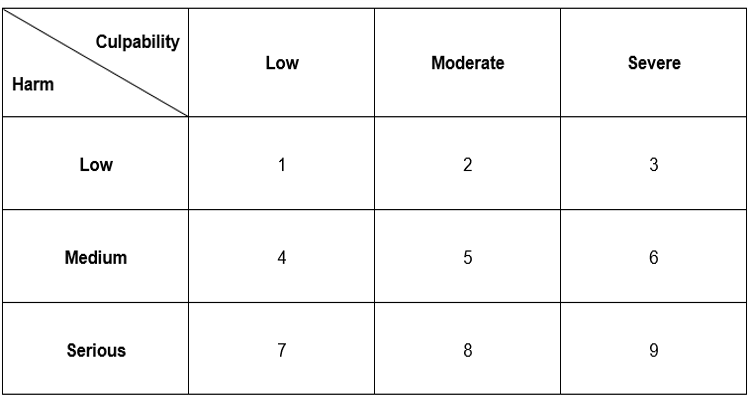
The level of Harm and Culpability are assessed on a case-by-case basis. For Culpability, conduct which tends to fall within the low to moderate range includes behaviour such as beating a red light. If there are multiple breaches of safe driving practices, it may be expected that Culpability will be higher, and where very dangerous conduct such as driving under the influence or road racing is concerned, these factors may push Culpability into the severe range.
For Harm, naturally if death is caused, it will fall within the serious range. Where victims have suffered multiple fractures or a degree of severe permanent injury, Courts have also tended to assess Harm at between the moderate to serious ranges. On the other hand, where there are no fractures or severe injuries, Harm tends to fall at the low end. It should be noted that potential harm to other road users is also accounted for in this analysis.
After the Court has decided its starting sentence, including whether or not a sentence of imprisonment is warranted, then the Court will adjust the sentence based on other relevant aggravating and mitigating factors. Some examples of other aggravating factors include whether the offender has a record of past driving offences.
In conclusion, understanding the law behind the offences of Reckless and Careless Driving can be a complicated and stressful procedure. The law is also continually developing in this regard, and the best advice one should walk away with is to drive safely and with proper consideration for the rules and for other road users.
In the July 2022 Singapore High Court (“SGHC”) decision in Public Prosecutor v Manta Equipment (S) Pte Ltd [2022] SGHC 157 (“Manta”), the SGHC reviewed the existing legal position on sentencing for offences committed under Section 12(1) of the Workplace Safety and Health Act 2006 (the “Act”). In so doing, the SGHC harmonised the divergent sentencing approaches in existing case law, and developed a new sentencing framework to be applied in cases where a body corporate is charged with offences under Section 12(1) of the Act.
To elaborate, Section 12(1) of the Act imposes a duty on every employer to “take, so far as is reasonably practicable, such measures as are necessary to ensure the safety and health of the employer’s employees at work.” A contravention of Section 12(1) is an offence, pursuant to Section 20 of the same Act.
Notably, the structure of the Act makes it possible for an officer of a body corporate to be charged and found guilty of an offence under Section 12(1), pursuant to Section 48(1) of the Act. Furthermore, while a body corporate may be liable to a fine not exceeding $500,000.00, an officer may be liable to a fine not exceeding $200,000.00, or to imprisonment for a term not exceeding 2 years, or to both.
Given the recently reported rise in offences under the Act in Singapore, officers of bodies corporate (such as directors or company secretaries) which find themselves at risk contravening Section 12(1) of the Act may wish to pay close attention to legal developments which flow from Manta. This is because, at the time of writing, there have been no reported decisions where the Manta sentencing framework has been modified to apply to a human officer for an offence under Section 12(1) of the Act.
Characterist LLC has recently had the opportunity to render our services to a client, who is a director of a construction company who had pleaded guilty to offences under Section 12(1) of the Act. In making our legal submissions on sentencing, we broached new grounds in being one of the first law firms to apply the Manta sentencing framework in a modified form to an accused person who was a human officer of a body corporate.
At the conclusion of our submissions, the Honourable Court ultimately adopted a proportional approach to sentencing, wherein the starting point was that the fine imposed on a human officer would lie at around 40% of that which would be imposed on a body corporate under the Manta sentencing framework. The basis of this position was that the maximum fine a company could face is $500,000.00 under the Act whereas a human officer would face a maximum fine of $200,000.00.
Although our work covered new and barely explored legal territory, the full impact of the Manta decision remains to be seen. Some open questions that remain include, for officers of bodies corporate, when it would be appropriate to impose a term of imprisonment for an offence under Section 12(1) of the Act, and whether the imposition of imprisonment should have any bearing on the fine (if any) that might be simultaneously imposed. These questions will have to be answered over the course of the incremental development of case law in time to come.
CONSTITUTIONAL CHALLENGE AGAINST VDS AND WVM (HC/OS 156/2022) – LOCUS STANDI, REAL CONTROVERSY AND PRACTICAL SIGNIFICANCE WHEN MEASURES ARE PARTIALLY DROPPED
INTRODUCTION
This update provides a commentary on the Singapore High Court’s recent decision (made in respect of two interlocutory applications filed in HC/OS 156/2022 (“OS 156”)) on the standing / “real controversy” requirement in the context of constitutional challenges against vaccine-differentiated safe management measures (“VDS”) and Workforce Vaccination Measures (“WVM”), where the law, policies, regulations, statistics and science are constantly evolving.
In particular, where an applicant has standing at the time of filing a constitutional challenge, does the applicant lose that standing with respect to the VDS / WVM which are dropped prior to the Court hearing? If so, what are the practical implications arising from this?
Characterist LLC’s Dominic Chan, Daniel Ng and Daniel Goh acted for the five Applicants in OS 156.
OS 156 – CONSTITUTIONAL LAW AND JUDICIAL REVIEW CHALLENGE AGAINST VDS AND WVM
On 18 February 2022, five Applicants filed a constitutional law and judicial review challenge (i.e. OS 156) against VDS (in relation to unvaccinated1 citizens) and WVM (in relation to unvaccinated workers).2
The challenge was based on the Applicants’ constitutional rights of freedom of movement, right to life or livelihood, freedom of assembly, equal protection and freedom of religion (see Annex A of the downloadable PDF for a summary of the arguments set out in the Statement in support of OS 156). The affidavits of the Applicants, followed subsequently by the expert affidavits of Dr. Harvey Risch and Dr. Peter McCullough (opining on inter alia the efficacy and safety profile of the Covid-19 mRNA vaccines), were filed in support of OS 156.
26 APRIL 2022 STOOD DOWN MEASURES, AMENDMENT AND STRIKING OUT APPLICATIONS
Before OS 156 was heard, on 22 April 2022, the MTF announced that it would be easing VDS measures from 26 April 2022, by lifting WVM and removing VDS from all settings save for 4 settings (“Stood Down Measures”)3. In the light of this development, the Applicants filed an amendment application (HC/SUM 2073/2022)4, while the Attorney-General (the “Respondent”) filed a striking out application (HC/SUM 2295/2022).
HEARING BEFORE THE AR, CENTRAL ISSUE, AND THE PARTIES’ KEY ARGUMENTS
Both applications were heard before an Assistant Registrar (the “AR”) on 12 August 2022. The central issue was whether the Applicants, who had standing when they filed the OS, continued to have standing (in latin, “locus standi”) to challenge the Stood Down Measures. One critical element of locus standi, is that there must be a “real controversy” between the parties. This element goes to the Court’s discretion, and not jurisdiction.5 “Where the circumstances of a case are such that a declaration will be of value to the parties or to the public, the court may proceed to hear the case and grant declaratory relief even though the facts on which the action is based are theoretical.”6
Respondent’s Arguments: The Respondent’s central argument (amongst other arguments) is that in the light of the Stood Down Measures, OS 156 had become hypothetical, academic or moot with respect to the Stood Down Measures, that there was no “real controversy” remaining between the parties and the Applicants no longer have standing in this regard, and therefore, the striking out application should be allowed. The Respondent made no submissions on: (1) the constitutionality of VDS / WVM; (2) the reasonableness or rationality of VDS / WVM (from an administrative law standpoint); or (3) the efficacy or safety profile of the Covid-19 vaccines.
Applicants’ Arguments: The Applicants argued (amongst other arguments) that the primary relief sought under the proposed amended OS, namely, a vindication of the Applicants’ constitutional rights, have substantial, personal and/or practical significance to the Applicants. In particular, the declaratory relief sought will be of great importance to the Applicants for the purposes of reversing or removing the stigma and ostracization (which the Applicants face)7, as well as various harms,8 which was set in motion, caused or contributed to by VDS / WVM, and which continue to remain notwithstanding the Stood Down Measures. In this regard, the Applicants pointed out to inter alia the following:
(1) Stronger Stance: The Ministry of Health’s press release “Calibrated Adjustments in Stabilisation Phase” (8 November 2021) where they stated:
“We are taking a stronger stance against those who choose not to be vaccinated, be it through the VDS, or by requiring them to pay for their medical bills.”9
(2) Step Down but Not Dismantle: The MTF had expressly reserved the right to implement and/or step up VDS or WVM again depending on the situation. In summary, the MTF had taken a “step down but not dismantle” posture (see e.g. the MTF’s 22 April announcement, and the Minister of Health’s statement made in Parliament on 9 May 2022). These statements confirm that VDS and/or WVM may come back, either in full force or in part.
(3) VDS which Remained in Force: The 4 Remaining VDS continued to remain in force.
(4) Empower, Embolden, Encourage: The Ministry of Manpower (“MOM”)10 had stated on 25 April 2022 (see the “Updated Advisory on COVID-19 Vaccination at the Workplace” dated 25 April 2022 (“25 April 2022 Workplace Advisory”)) that employers may continue to implement VDS and/or WVM on their own accord,11 thereby effectively making vaccination status an acceptable or permitted ground of discrimination for hiring. The Applicants submitted that this has or will effectively empower, embolden and/or encourage employers to continue the imposition of VDS and/or WVM against unvaccinated workers (including some of the Applicants) in various circumstances in terms of current and/or future employment.
(5) Cloud of Fear and Uncertainty: In addition, in the light of the above, the Applicants continued to live under a cloud of fear and uncertainty that VDS / WVM may come back anytime to severely and suddenly upend their lives (and their families’ lives) again
THE AR’S DECISION, THE APPEALS AND SUBSEQUENT DEVELOPMENTS
At the hearing of the applications on 2 September 2022, the AR preferred the Respondent’s arguments over the Applicant’s arguments, and followed various recent UK and Canadian court decisions cited by the Respondent12 over various Malaysian and US cases cited by the Applicants.13 Accordingly, the AR disallowed the Applicants’ amendment application, and struck out OS 156, save for the dining VDS under OS 156 (in respect of which the Respondent did not challenge the Applicants’ standing).
The Applicants appealed to a High Court Judge in chambers, and the appeals were fixed for hearing on 18 October 2022.
On 7 October 2022, the MTF announced that they “will lift VDS fully” from 10 October 2022.14 On 7 October 2022, the MOM15 also updated its advisory on Covid-19 vaccination at the workplace (“7 October 2022 Workplace Advisory”).16 In the light of these latest developments, the Applicants withdrew the appeals and OS 156.
COMMENTARY
First, it is important to note that the various announcements of the MTF and related ministries, including the ones which communicate clear decisions implementing VDS / WVM, are not susceptible to judicial review or constitutional challenge until and unless they are enshrined in subsidiary legislation or regulations.17 This is because until such time, they do not have legal effect. This legal position is different from how the average layperson would likely perceive the way Covid-19 measures have been implemented. Even though the enshrining of VDS / WVM in the various regulations typically takes place a few days after each announcement of the MTF, and appear to be mere formalities flowing from clear executive decisions, the legal position established by the Singapore courts is that only the legislation or regulations are susceptible to judicial review.
Second, and flowing from the first point above, it is dissatisfactory that weighty advisories (made by the MOM amongst others) such as the 25 April 2022 Workplace Advisory are not susceptible to court challenge,18 especially insofar as it had or would have had an impact on how employers behaved vis-à-vis their unvaccinated employees and thus affecting actual legal rights, albeit indirectly. Importantly, insofar as such an advisory has had the effect of perpetuating the stigma and ostracization which unvaccinated workers faced in terms of current and/or future employment, Singapore’s narrow approach to the “real controversy” issue, whereby locus standi to challenge the constitutionality of WVM was lost due to the revocation of the regulations embodying WVM, would make it exceedingly difficult for such workers to seek redress from the Court.
Third, given that standing may be lost once the regulations (embodying the VDS and/or WVM) being challenged are revoked, insofar as VDS and/or WVM are reimplemented (whether in a similar or different form), it is imperative for any future constitutional challenge and/or judicial review application to be filed, and heard and determined on an urgent and expedited basis.19 This would mean that interested applicants would have to marshal substantial resources very quickly, to prepare their case based on the latest laws, policies, facts, statistics and/or expert scientific evidence.
The Health Minister Mr. Ong Ye Kung has said that “when the situation requires, we may have to step up VDS to an appropriate level, in order to protect those who are not up to date with their vaccination.”20 There is a real likelihood that VDS and/or WVM, in various permutations or forms, may continue being reimplemented in the future. They may also be revoked at short notice, thereby making any substantial constitutional and/or judicial review by the Court highly elusive. To ensure that the Court is able to engage in any substantive constitutional and/or judicial review of VDS and/or WVM, the law effectively requires any applicants to proceed on an expedited basis, and to seek urgent hearing dates as far as possible.
Footnotes
1 By virtue of the Government’s definition of being fully vaccinated, VDS and WVM had applied not only to unvaccinated persons, but also to partially vaccinated persons, those who did not qualify for medical exemptions, as well as vaccinated persons who did not receive their necessary booster to maintain their vaccination status.
2 VDS and WVM as announced by the Multi-Ministry Taskforce (“MTF”) and related ministries on 6 August 2021, 9 October 2021, 23 October 2021, 20 November 2021, 14 December 2021, and 26 and 27 December 2021 (collectively, the “Decisions”), and embodied in inter alia the following regulations: (1) Workplace Safety and Health (COVID-19 Safe Workplace) Regulations 2021, Regulations 9 to 13, and 30; (2) Infectious Diseases (COVID-19 Access Restrictions and Clearance) Regulations 2021, Regulations 6, 7A, and 9, and the Second Schedule; (3) COVID-19 (Temporary Measures) (Control Order) Regulations 2020, Regulations 6 and 8, and the First Schedule and Third Schedule; (4) COVID-19 (Temporary Measures) (Sporting Events and Activities – Control Order) Regulations 2021, Regulations 5, 7, and 14; (5) COVID‑19 (Temporary Measures) (Business Events — Control Order) Regulations 2021, Regulations 4 and 8; (6) COVID‑19 (Temporary Measures) (Performances and Other Activities — Control Order) Regulations 2020, Regulations 7A, 12A, 14, and 21A; (7) COVID-19 (Temporary Measures) (Religious Gatherings — Control Order) Regulations 2021, Regulations 8, 15, and 28A (collectively, the “Statutes / Regulations Embodying the Decisions”).
3 Namely, (1) Events with more than 500 participants at any one time; (2) Nightlife establishments where dancing among patrons is one of the intended activities; (3) F&B establishments, including restaurants, coffeeshops and hawker centres; and (4) Casinos (collectively, the “4 Remaining VDS”).
4 To pivot the main relief sought, from a quashing order (a remedy under judicial review) to freestanding declaratory relief (under O.15, r.16 of the Rules of Court, 2014) on the constitutionality of VDS / WVM (with respect to the Stood Down Measures, as well as the 4 Remaining VDS) as the main relief (in the original OS 156, this was a further relief sought under the facilitative provision under Order 53 of the Rules of Court, 2014), while maintaining the prayer for a quashing order with respect to the 4 Remaining VDS.
5 Tan Eng Hong v Attorney-General [2012] 4 SLR 476 (“Tan Eng Hong”) at [115] and [137].
6 Tan Eng Hong at [143].
7 Namely, that VDS and/or WVM exposed the Applicants to alienation, segregation, marginalization, ridicule, contempt and/or avoidance by or from the rest of society, effectively making them into 2nd class citizens and/or a new substratum of society.
8 See [6] of Annex A of the downloadable PDF for an elaboration of such harms.
9 Emphasis in bold added.
10 Together with the National Trades Union Congress (“NTUC”) and the Singapore National Employers Federation (“SNEF”), etc.
11 The material portions of the 25 April 2022 Workplace Advisory (at [6]) include: “Taking into consideration the workplace health and safety and operational needs of their respective companies or sectors, employers may implement vaccination-differentiated requirements for their employees (such as disallowing unvaccinated employees from entering the workplace), as a matter of company policy and in accordance with employment law. For unvaccinated employees whose jobs require working on-site as determined by the employers under such a company policy, employers may … [redeploy them or place them on no-pay leave based on mutually agreeable terms, or]… As a last resort after exploring options above, terminate their employment (with notice) in accordance with the employment contract. If the termination of employment is due to employees’ inability to be at the workplace to perform their contracted work, such termination of employment would not be considered as wrongful dismissal.” [Emphasis in bold added].
12 The applicants in the UK and Canadian cases were held to have lost their standing to challenge the COVID-19 regulations once they had been removed from the statute books.
13 In the Malaysian case, the Court held that a person had standing to challenge a revoked criminal law even after it had been repealed, while in the US case, the Court held that the applicant had standing to challenge the revoked COVID-19 visitor policy (barring Catholic clergy from ministering in-person to the spiritual needs of inmates) even after it had been removed (the AR held that this case was of limited relevance to the present matter, as, amongst other things, the standard for finding that a case is justiciable under US law appears to be different from Singapore law).
14 The MTF elaborated that this “means that VDS will no longer be required for (i) events with more than 500 participants at any one time, (ii) nightlife establishments where dancing among patrons is one of the intended activities, and (iii) dining in at F&B establishments, including hawker centres.”
15 Together with the NTUC and the SNEF, etc.
16 Amongst other things, the 7 October 2022 Workplace Advisory provides (at [4]-[5]) that:
“4. With the lifting of VDS, the tripartite partners are of the view that employers should take the decision to remove vaccination-differentiated requirements for access to the workplace. However, employers may consider whether the situations in para 5 below are applicable.
Vaccination-differentiated requirements for specific occupations
5. If there are genuine occupational requirements, employers, taking into consideration the workplace health and safety and operational needs of their business, may continue implementing vaccination-differentiated requirements for their employees to access the workplace (such as deploying only vaccinated individuals), as a matter of company policy and in accordance with employment law. For example, employers may require their employees to be fully vaccinated before entering the workplace because their employees have to work closely with vulnerable individuals (which may be the case for allied healthcare professionals, nurses and doctors in hospitals and clinics); or the employees’ job scope involves travelling to countries with vaccination-differentiated entry requirements.”
[Emphasis in bold original].
17 The AR applied Han Hui Hui and ors v Attorney-General [2022] SGHC 141 (“Han Hui Hui”) at [58]-[59] (see footnote 18 below for an elaboration), and held that the prayers to challenge inter alia the Decisions of the MTF do not disclose any reasonable cause of action and should be struck out.
18 In this regard, see Han Hui Hui at [58]-[59], where the High Court held that the “Updated Advisory on COVID-19 Vaccination at the Workplace” dated 23 October 2021 (the “October Advisory”) does not amount to a policy directive, nor does it carry legal effect. It is also not the source of any legal obligations to comply with the WVMs as it merely reiterated the Government’s announcement of the WVMs. The WVMs were instead implemented by subsidiary legislation and derive their legal force from them. For the lack of legal effect, the October Advisory cannot be subject to a quashing order. Applying Han Hui Hui, as well as the AR’s decision (applying Han Hui Hui at [58]-[59]) that even the MTF’s Decisions do not have legal effect and cannot be subject to a quashing order (see footnote 17 above), the 25 April 2022 Workplace Advisory would likewise lack legal effect, and cannot be subject to a quashing order.
19 In this regard, see [31]-[32] of R (on the application of Hussain) v Secretary of State for Health and Social Care [2022] EWHC 82:
“31. … Whether expedition and an urgent rolled up hearing would be appropriate in the context of any future PCW [i.e. prohibition on collective worship, in response to the Covid-19 pandemic in UK, in conjunction with the “lockdown”] and any future prompt challenge to its legality invoking Article 9, is an open question. But if those steps are appropriate in those future circumstances, in the judgment of the Court dealing with that situation, then they will be granted.If they are not granted, it is because they are not appropriate. That is as it should be. There is nothing here approaching any deficit in the Court’s ability to provide an appropriate response which would justify, in the public interest, allowing the present claim to proceed by means of an “historic” analysis of the justification for the PCW in the circumstances as they were in and after March 2020 or May 2020. The correct position in principle is – and has to be – that the Courts have, and will always seek to discharge, the responsibility of delivering practical and effective justice, consistently with the overriding objective…
32. A claim challenging a future PCW – if the Claimant considers a challenge to be justified and if he seeks his ‘day in court’ – could be pursued with conspicuous and demonstrable promptness, pointing to all these considerations. Instead of pressing for interim relief, the Claimant could be asking for the Court’s resources to be channelled into an expedited ‘rolled-up’ hearing. There would need to be a reworked JRG [i.e. judicial review grounds]. But that is as it should be, to ensure a disciplined focus and to engage judicial review remedies designed to be practical and effective. The Court will respond in the way that it judges promotes the interests of justice and the public interest. That is a good and sufficient answer … This is an important recognition. If there were to be a future PCW, and if the Claimant sought promptly to challenge its Article 9 compatibility, the Defendant would need to think carefully about what position it takes in the proceedings – given the duty of (candour and) cooperation – so far as concerns the facilitation of prompt resolution of the substantive legal merits.”[Emphasis in bold added]
20 See [19] of the Minister’s Opening Remarks at the MOH Press Conference to Update on the Covid-19 Situation on 15 October 2022.